
The middle mile rarely gets attention until it breaks.
It is the stretch between a local network and the place where traffic meets the wider internet: the regional fiber that carries a rural tower’s traffic back to a data center, or the link from a remote substation to a utility’s operations center. When it goes down, everything downstream goes with it, however well the last mile was built.
On Wednesday, November 18, Contrivian Founder & CEO Grant Kirkwood joins the panel “Middle Mile in Orbit: Where Satellite Fits Between Backhaul and Data Centers” at Broadband Nation Expo in New Orleans. Ahead of that conversation, here is how we think about the question.
Route diversity has usually meant more fiber
The standard answer to middle-mile risk is a second route. Run another fiber path, ideally along a different right of way, so one cut doesn’t take the site off the network.
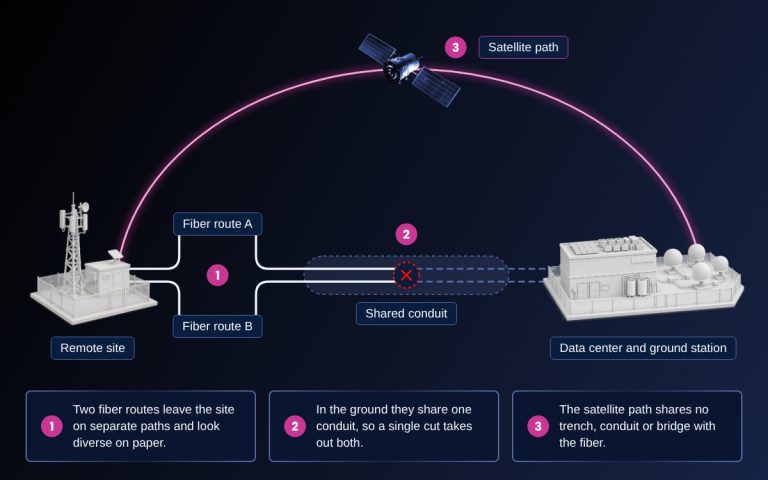
In practice that answer runs into two problems. A truly separate route is expensive, and in rural and remote areas it may not exist at all. And routes that look separate on a map are often close together in the ground. Two carriers’ fiber can share the same conduit, cross the same bridge or follow the same rail corridor for miles. One construction crew or one flood can take out both. On paper the site has two routes. In the field it may have one.
A path that doesn’t share the trench
A satellite link has no physical infrastructure between the site and the ground station. It doesn’t run through the conduit, cross the bridge or hang from the same poles. That makes it a different kind of second route, one that a backhoe or a washed-out road can’t reach.
Low Earth orbit has made this practical in places where it wasn’t before. LEO service has far lower latency than geostationary satellite, so interactive applications can run over it, and terminals can be in place in days rather than the months a new fiber build takes. With more than one constellation now available, a site can have diversity in orbit as well as on the ground. That is the idea behind Contrivian Constellation™, our multi-constellation LEO service.
Running every path at once
Having a satellite path is half of it. How it’s used decides whether it helps.
Contrivian keeps every path active at the same time. Fiber, microwave, cellular and satellite all carry traffic, and our software measures each one continuously. It sends each application to the path that suits it right now and moves traffic when conditions change. A degraded fiber route doesn’t wait to fail before traffic shifts, and a satellite path that has been carrying traffic all along is already proven when the site leans on it.
It also changes what the satellite path is worth on an ordinary day. Instead of sitting idle, it adds capacity and gives the software another option for traffic that can tolerate more delay. The site gets value from it every day, well before the day the fiber is cut.
What the software layer has to handle
Satellite and fiber behave differently, and the software has to account for that.
Latency differs between paths. Voice, video and control traffic care about delay. Bulk transfers care about capacity. The software steers each kind of traffic to the path that fits it, instead of treating every link as interchangeable.
LEO satellites move. A terminal regularly hands off from one satellite to the next, and a handoff can show up as a brief change in latency or a short burst of packet loss. A system tuned for terrestrial links can read a routine handoff as an outage and pull traffic off a healthy path. The software needs to recognize the pattern for what it is and keep traffic where it belongs.
Sessions need a stable identity. If traffic moves between a fiber path and a satellite path and the public IP address changes with it, VPNs drop and calls end. Contrivian Lighthouse™ gives the site a carrier-independent public IP, so sessions stay up as traffic moves between networks.
Where satellite is the wrong answer
Satellite doesn’t replace middle-mile fiber where fiber is available and diverse. A single terminal carries far less capacity than a fiber pair, so a site moving large volumes of data back to a data center still needs terrestrial transport for most of it.
It also isn’t the first choice where an independent second terrestrial route already exists at a reasonable cost. A satellite path earns its place where the alternatives are an expensive new build, a second route that shares the first route’s risks, or nothing at all. That describes a lot of remote towers, substations, pump stations and field sites.
The conversation in New Orleans
The middle mile is moving toward a mix of transport: fiber where it reaches, microwave where it’s cheaper to build, cellular where coverage is strong and satellite where nothing else is independent. The open question is how those paths work together, and who decides which one carries what.
Grant takes that question on with Rick Ward of OrbitEdge, with Tom Stroup of the Satellite Industry Association moderating, at Broadband Nation Expo. If you’re at the show, come find the Contrivian team. If you’re planning middle-mile diversity for remote sites, talk to a Contrivian specialist about running satellite alongside the paths you already have.