
An oil and gas site forty miles from the nearest town.
A mine with one road in and one road out. A cell tower at the edge of a rural coverage map. These are the places where industrial and telecom operators run critical infrastructure, and they are also the places where connectivity is hardest to get right.
For years, the standard approach was simple out of necessity: whichever provider could reach the site got the contract. If that meant one circuit, one vendor, and one point of failure, that was the tradeoff for being connected at all.
That tradeoff is starting to look worse than it used to.
What changed
Two things shifted the math. First, the amount riding on that single connection has grown. A remote site today isn’t just sending occasional status updates, it’s running SCADA systems, streaming sensor data, supporting remote operators, and in some cases carrying safety-critical communications. Second, the number of ways to reach a remote site has grown too. Low-earth-orbit satellite constellations, improved cellular coverage, and software that can orchestrate across multiple circuits at once mean that “one provider or nothing” is no longer the only option, even at the most remote sites.
The case for multi-path
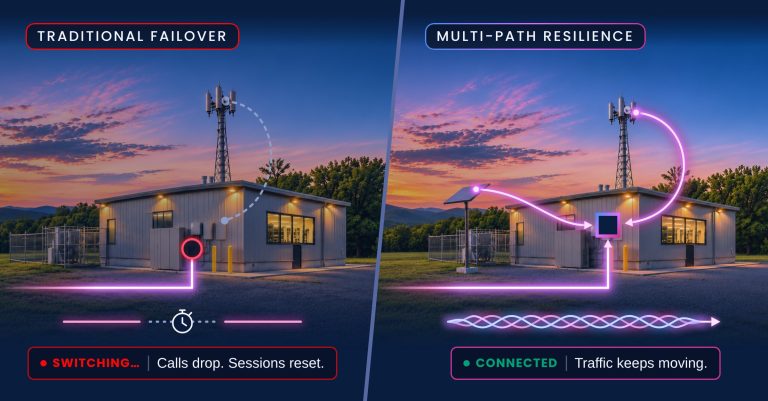
Running two or more independent paths into a site, say, a satellite link and a cellular link, isn’t just redundancy for its own sake. It’s a different risk model entirely. A single-provider site has one thing that can go wrong: that provider’s network. A multi-path site has to lose every path at once for the same failure to happen, a far less likely event, and even then, most outages don’t take down every path simultaneously.
Active-active configurations, where multiple paths carry traffic simultaneously rather than one sitting idle until needed, take this further. Instead of waiting for a circuit to fail before switching, the system is already distributing traffic across paths, so a degrading circuit affects less of what’s running through it, not all of it.
Why this hasn’t happened everywhere yet
If the case is this strong, why do so many remote industrial and telecom sites still run on a single provider? Mostly, inertia. These sites were often connected years ago, under a different cost structure and a different risk calculus, and nobody has revisited the setup since. Multi-path deployments used to mean more hardware, more vendors to manage, and more complexity than most operations teams wanted to take on for a site that, most of the time, worked fine.
That calculus is changing as the software managing multiple paths gets simpler to deploy and the cost of a connectivity failure at a critical site keeps climbing. For an industry built on operating in places infrastructure doesn’t reach easily, betting an entire operation on one connection is a narrower bet than it used to be.
Where Contrivian fits
Contrivian Lighthouse™ is built for sites like these. It runs every available path active-active, from LEO satellite to cellular to whatever fiber reaches the property, and continuously measures latency, jitter, and packet loss on each one. Traffic shifts to the best-performing path before a degrading circuit affects the people and systems that depend on it. For the operations team, that means one Contrivian Lighthouse Gateway on site and one accountable team behind it.
The well forty miles out, the mine at the end of one road, the tower at the edge of the map: none of them should go dark because one provider had a bad day. Talk to our team about what multi-path looks like at your site.