
Contrivian Launches Lighthouse 2.0 to Orchestrate Enterprise Networks Across Fiber, 5G and Satellite
SAN FRANCISCO, CA – October 27, 2026 – Contrivian, a software-led technology company providing intelligent, mission-critical connectivity, has released Version 2.0 of its award-winning Contrivian Lighthouse™ software platform. The new release enables enterprises to manage and control fiber, broadband, 5G…

Why Connectivity Needs a Software Layer, Not Just Better Networks
By Grant Kirkwood — Organizations now have more ways to get connected than ever (fiber, cellular and satellite), yet their communications are barely harder to knock out. Kirkwood argues that the number of links was never what made a network resilient; what matters is the logic that decides between them. That decision is a software problem, not a purchasing one: software can watch every link, react as conditions change and send each application down the path that suits it. A link that is up is not necessarily performing, so connections need active management, not simply extra circuits.

Engineering Failure Out of Connectivity
By Grant Kirkwood: Kirkwood argues that the industry habit of designing networks around expected failure no longer works. The alternative he sets out is active, multi-constellation connectivity steered by real-time path data, with software measuring fiber, broadband, 5G and LEO links and moving traffic before users notice a problem. He points to government, energy, mining and remote infrastructure as sectors where always-on expectations make this essential. LEO satellites bring global reach and fast deployment, but he presents them as one part of a wider network rather than a complete answer on its own.

Contrivian Launches Government Solutions Division to Deliver Secure, Mission-Critical Connectivity for US Federal Agencies
Contrivian has launched Contrivian Government Solutions, a dedicated division delivering secure, mission-critical connectivity for U.S. federal agencies and defense organizations. The division is built around the distinct service, security and procurement requirements of federal and defense customers.
Resiliencia en comunicaciones críticas: la conectividad debe llegar junto a los equipos de emergencia (Resilience in critical communications: connectivity must arrive with emergency teams)
By Grant Kirkwood: Written in Spanish for a critical-communications audience, the piece opens with wildfires, which now spread faster than the systems built to fight them. Mobile towers overload or burn and fiber is cut, while responders arriving from elsewhere need working connections the moment they reach the field. Because every minute counts in evacuations and resource decisions, the argument is that connectivity cannot be restored afterwards. It has to be planned in advance and arrive with the emergency teams.

How Low Earth Orbit (LEO) Satellites Can Redefine Public Network Resilience
By Grant Kirkwood: Government agencies have invested heavily in failover, but Kirkwood argues that failover still builds interruption into the network design. When a dispatch call drops or a command feed freezes, the operation has been disrupted even if the link recovers within seconds. He calls for a higher standard in which fiber, broadband, cellular and LEO satellite run together in real time. LEO matters because it does not depend on the same local fiber, towers or backhaul, so agencies should ask whether the public service keeps running when part of the network fails.

LEO satellites, 5G and the rise of resilient connectivity
Video interview with Grant Kirkwood: Kirkwood explains why managed service providers are treating connectivity resilience as a strategic priority. He links this to businesses becoming more dependent on always-on networks and on the MSPs that run them. The conversation covers LEO satellite and 5G as building blocks for resilient connectivity.

Designing and De-Risking Government Satellite Strategies
By Grant Kirkwood: Public agencies have been rethinking communications continuity since a July 2025 software fault in Starlink’s control systems cut its capacity sharply for more than two hours. Kirkwood argues that moving communications into orbit does not make them resilient by itself, because relying on one satellite provider swaps one single point of failure for another. He cites Hurricane Helene, when satellite became responders’ last working link in western North Carolina and sped up government adoption of LEO. Resilience, he concludes, is an architecture question, since a single constellation with shared software and ground systems can still fail as a whole.
Contrivian Completes Big Network Merger, Creating a Software-Led Provider Ready to Serve Global Demand for Mission-Critical Connectivity
SAN FRANCISCO – July 21, 2026 – Contrivian, a technology company providing intelligent mission-critical connectivity, and Big Network, a software innovator focused on ultra-reliable networking, today announced the successful completion of their merger. The transaction brings Big Network’s proprietary networking…
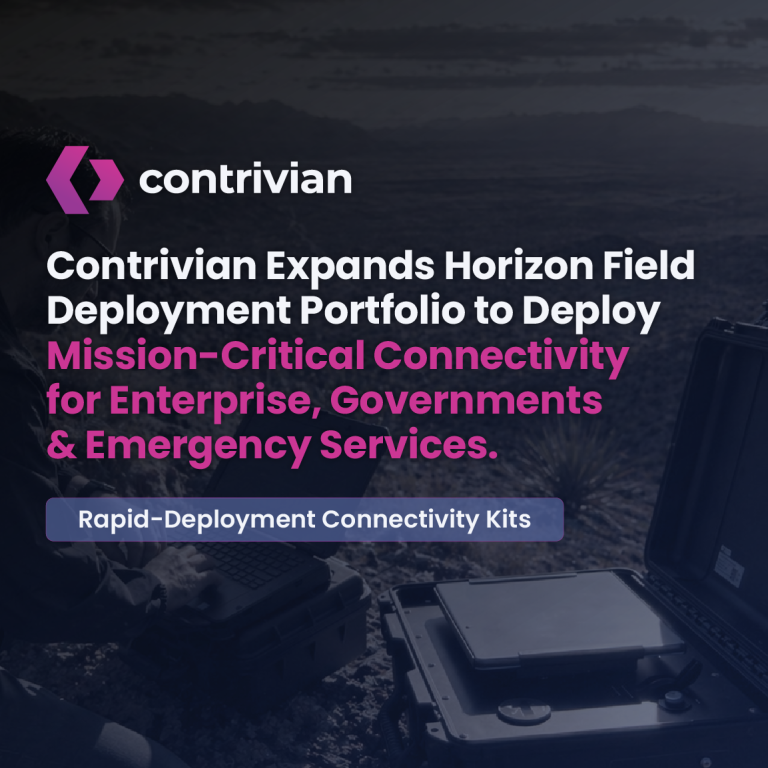
Contrivian Expands Horizon Portfolio to Deploy Mission-Critical Connectivity for Enterprise, Governments and Emergency Services
The launch of the Contrivian Horizon™ Plus delivers accessible, user-friendly, enterprise-grade field connectivity for military, healthcare, law enforcement and government services.

Failover is Failure: Architecting the Future of LEO
By Grant Kirkwood: Kirkwood argues that failover, where a backup link takes over after the primary connection drops, is too slow for today’s networks. Businesses now run real-time, always-on applications that lose sessions or data during even short interruptions. A failover is therefore a delayed response to damage that has already happened, not true resilience. Networks instead need to detect and route around performance problems before they reach users.

Startup challenging satellite industry’s multi-orbit playbook
By Sandra Erwin: SpaceNews profiles Contrivian and its challenge to the satellite industry’s multi-orbit playbook, with a vendor-agnostic approach to combining satellite networks.

One Orbit, Many Constellations: Rethinking How Enterprise Satellite Networks Should Be Built
By Grant Kirkwood: Kirkwood argues that the satellite industry has reached a point where network design matters almost as much as the satellites themselves. He separates multi-orbit designs, which mix LEO, MEO and GEO layers, from multi-constellation designs, which combine several networks at similar altitudes. The two terms are often used interchangeably, and he says the confusion affects performance, reliability and enterprise adoption. Clearer shared language would help buyers understand what they are purchasing and keep providers from overstating what they offer.

Contrivian Constellation promises terrestrial-like redundancy via LEO satellites: Interview
By Ian Doescher: Since 2023 Contrivian has helped businesses and government agencies add backup paths across fiber and 5G so critical connections stay up. Its newly launched Constellation product extends that resilience to satellite. Kirkwood explains that LEO latency is less predictable than on ground networks, so Constellation pools several providers such as Starlink and Amazon Leo. Its software re-balances traffic every 200 milliseconds, and customers do not need satellite subscriptions of their own.

How Contrivian is Engineering Terrestrial-Grade Connectivity Through LEO Networks
By Daniel Mena: The article opens with a search-and-rescue team in Texas Hill Country after the July 2025 floods, working with cell towers and fiber down and relying on a LEO satellite link. Their drone lost its command link while flying beyond line of sight, freezing the video feed and halting the search. The writer argues that networks have not kept pace with autonomous drones and sensors and are often designed as if they will always work. Contrivian’s multi-path, active-active approach is presented as an answer to that gap in resilience.
Contrivian: Grant Kirkwood on Multi-Constellation Connectivity and Resilient Network Design, Podcast
By Doug Green: Recorded at the Channel Partners Conference & Expo, the podcast has Doug Green speaking with Kirkwood about resilient connectivity. Kirkwood describes how Contrivian brings LEO satellite and terrestrial networks into one software-defined platform aimed at fiber-like resilience. The platform combines satellite, fiber, LTE/5G and broadband with dynamic routing for mission-critical environments. He also explains how this lets channel partners sell outcomes rather than components, without managing multiple vendors.

Podcast Interview: Contrivian introduced Contrivian Constellation
By Doug Green: Doug Green, publisher of Telecom Reseller, shares coverage of the Contrivian Constellation launch alongside his podcast interview with Grant Kirkwood, recorded at Channel Partners.

Contrivian orchestrates LEO satellite service across Starlink and Amazon Leo
By Linda Hardesty: Fierce Network profiles Contrivian as a San Francisco startup that began by managing broadband and wireless links for businesses before moving into satellite. Kirkwood stresses that the company is more than an SD-WAN vendor, serving multinational customers with many sites and coordinating several SD-WAN networks at once. Its differentiator is software built for LEO internet, which can pool multiple Starlink connections for capacity or back up fiber-connected sites. He argues Starlink behaves differently from conventional broadband, so the routing layer has to account for it.

Contrivian is the under-the-radar connectivity play MSPs need to know
By Phil Harvey: Channel Dive’s editor profiles Contrivian as a self-funded company of about 30 people that has built a channel business around connectivity failures, including cases where a backup link has quietly stopped working. The piece covers the newly launched service that combines LEO networks such as Starlink and Amazon Leo under one contract, one IP address and one data plan. Nearly all revenue flows through VARs, MSPs and distributors. Public-sector customers still make up most of the base, but enterprise is the faster-growing segment.

Contrivian Launches New Product Bundling Amazon Leo & Starlink
By Douglas Gorman: Satellite internet customers have usually had to commit to a single provider, and Payload reports that Contrivian’s new product removes that constraint. Contrivian Constellation bundles Amazon Leo and Starlink with one data plan, one contract and one IP address. Instead of a primary-and-backup setup that can take seconds to switch, Contrivian’s Lighthouse technology measures both networks continuously and sends traffic over the better path. Kirkwood explains that satellite signals can drop or be blocked moment to moment, so both networks run in parallel at all times.