Most connectivity providers sell circuits and call it a day.
Contrivian sells circuits bundled with software that decides what to do with them.
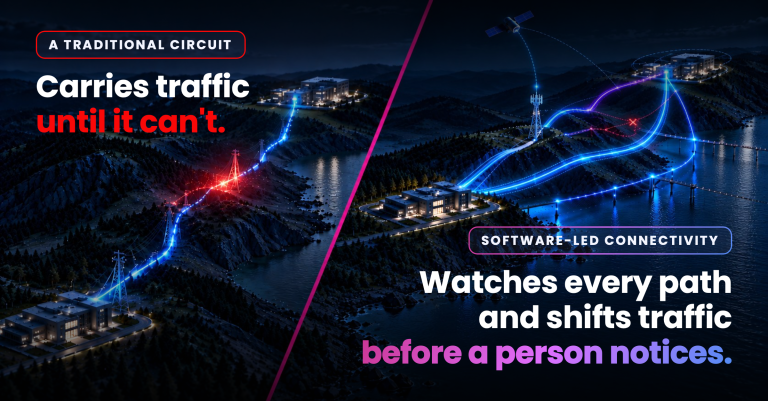
That distinction sounds small until a link degrades at 2 a.m. and nobody is watching a dashboard. A traditional circuit does exactly one thing: it carries traffic until it can’t. What happens next, whether an application reroutes, whether a session survives, whether anyone even finds out, is left to whatever hardware or person happens to be paying attention.
Contrivian was built on a different premise: that connectivity should behave like software. Not because software is a trend, but because software is the only layer that can watch every path in real time, make a routing decision in milliseconds, and keep every application running without waiting for a person to notice something broke.
What “software-led” actually means
In practice, it means three things.
First, the network is observed continuously, not checked periodically. A software-led system doesn’t wait for a support ticket to learn that a circuit is degrading. It sees the degradation as it happens, across every connection carrying traffic for a customer, all the time.
Second, the response is automated. When a path stops performing, the decision to move traffic off it happens in software, not in a call center. That’s the difference between a connectivity problem that resolves in milliseconds and one that resolves after someone escalates it.
Third, the model is carrier-neutral by design. Because the intelligence lives in software rather than in a specific piece of hardware or a specific carrier’s network, Contrivian can orchestrate across circuits from different providers, including satellite constellations, cellular, and fiber, and treat them as one coherent system rather than a stack of separate vendor relationships.
Why this matters more than it used to
Ten years ago, most businesses could tolerate a connectivity blip. A dropped call, a slow page load, a few minutes of downtime, these were inconveniences. Today, the same blip can mean a missed transaction, a disconnected field team, or a public safety response with no way to communicate.
That combination, higher stakes and harder environments, is exactly the gap that software-led connectivity is built to close. It’s not a faster circuit. It’s a system that makes the circuits a customer already has behave more predictably than any one of them could on its own.
What this looks like day to day
For a customer, this usually shows up as an absence rather than a presence: fewer outage calls, fewer “is it just me” moments, fewer times an application quietly degrades without anyone knowing why. The software is doing its job when nobody has to think about the network at all.
That’s the model. Not a bigger pipe. Not a better carrier. A layer of software that watches, decides, and acts faster than a person could, so the businesses and teams relying on it don’t have to.